I Tried Sony Lenses on My Nikon… It Actually Works
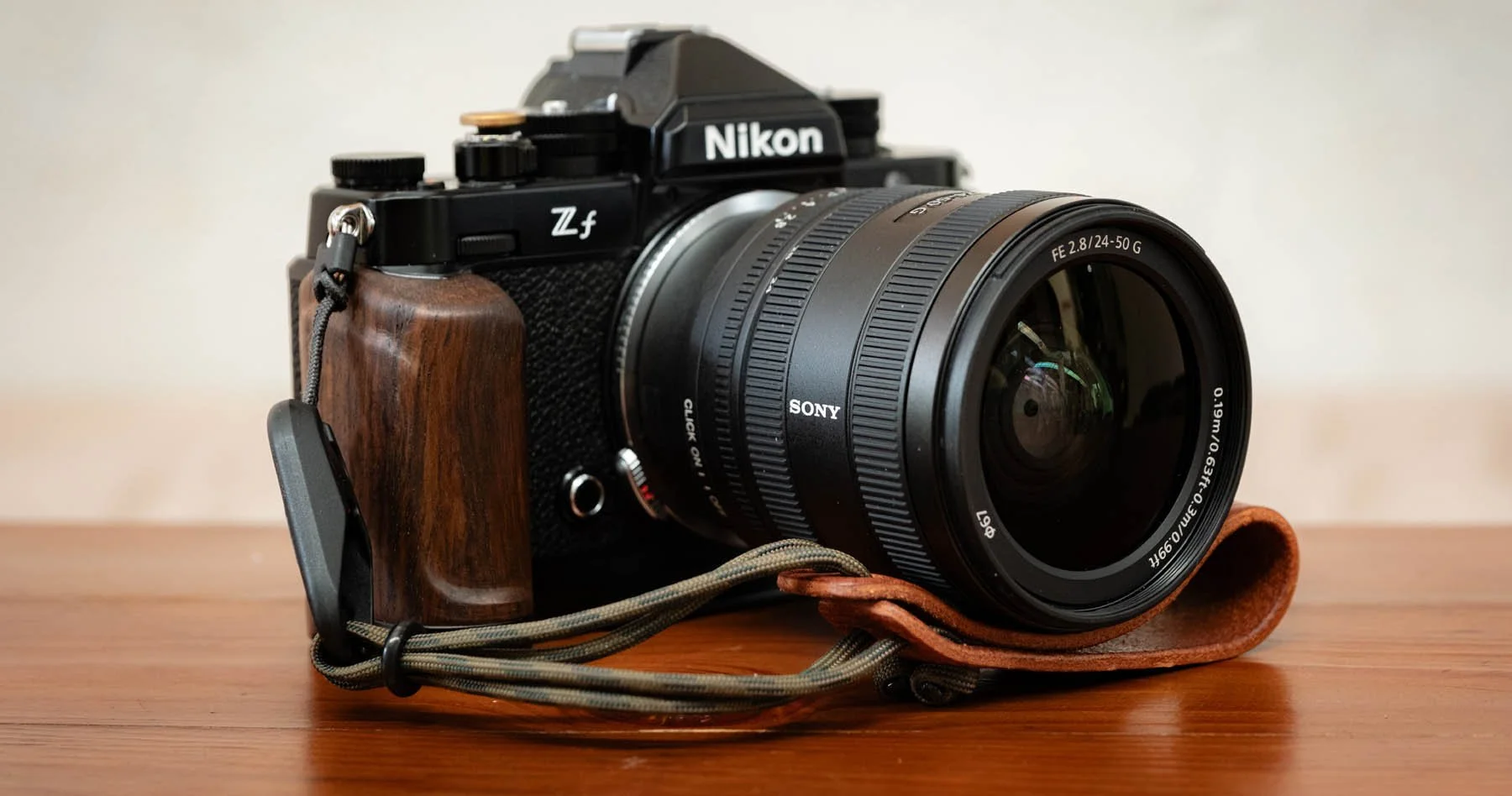
So, I bought a Sony FE 24-50mm f2.8 for my Nikon Zf and if you’re like me, you probably have quite a few questions. Why this lens instead of a Nikon lens? How does this work and does it actually work reliably? There must be drawbacks right, you can’t just use another brands lens on a camera… Can you?
I had all of these questions myself and couldn’t really find great answers online, thus I’ve spent the last 4 months living with this setup to test the auto focus, functionality, and discover all the quirks and features of mashing two brand’s together into what I think is an ultimate setup. The results? Well they were better than I expected and the best part was discovering what this means for the future of Nikon’s Z Mount.
Why the Sony FE 24-50mm f2.8?
It’s simple, there’s no other lens like it. Ultimately I wanted a lightweight, small lens to walk around with all day. Nikon doesn’t have that many options that fit this unless I want to stick with their smaller primes like the 40mm f2 or 28mm f2.8. If you want a lens that can shoot f2.8 you’re looking at the much larger and heavier Nikon 24-70mm f2.8 II or the Nikon 28-75mm f2.8. If you want comparable size and weight, the best option is the Nikon 24-70 f4, which was what I was going to buy until this idea popped up in my research. Mainly because I really wanted an f2.8 lens and ultimately find myself shooting between 28-50mm most of the time anyways.
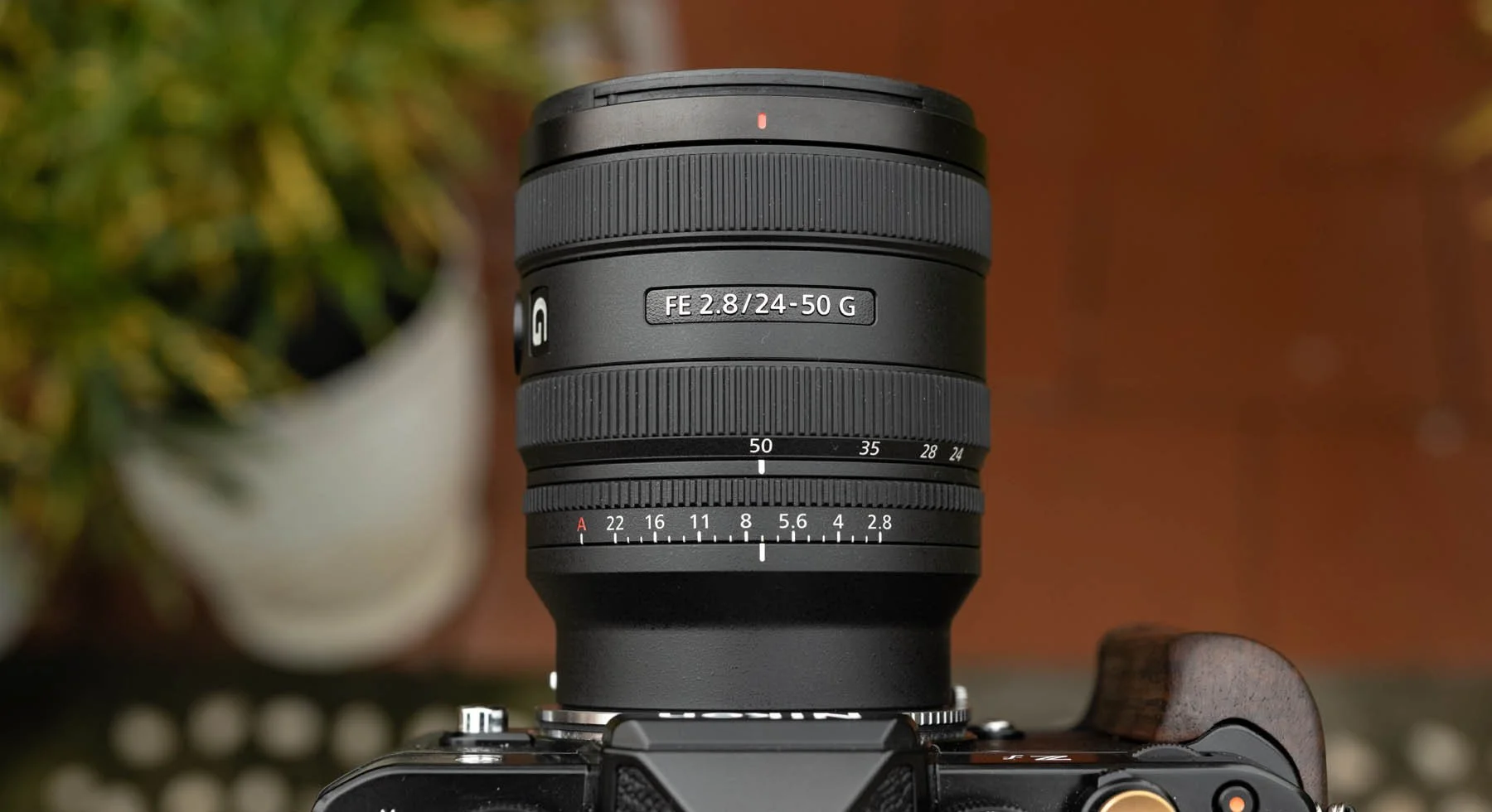
A huge upsell as well is the clickable aperture ring on the Sony FE 24-50mm f2.8. I realize some of you could care less about this but having a clickable aperture ring when combined with the Nikon Zf really enhances the experience, giving you all 3 settings on tactile dials. Something Nikon lenses lack, sadly.
Without trying to be too hyperbolic, if Nikon released the exact same lens for native Z mount but without the aperture ring, I would still prefer the Sony even with some of the annoyances you have to deal with in regards to adapting the lens to Z mount (more on that later).
Adapting Sony E Mount to Nikon Z Mount
One of the best features of Nikon’s Z mount is that it has the shortest flange distance of all the major camera manufacturers. If you’re unfamiliar, flange distance is the distance from the sensor to the lens mount. This means that to adapt lenses from other models, you have to add space between the sensor and the lens mount. If you’ve ever adapted an older DSLR lens like Canon’s EF Mount or Nikon’s DX to a newer mirrorless camera, these adapters essentially just add space (or air) between the new mirrorless mount to the older DSLR lenses that had larger flange distances.

Sony FE 24-50mm f2.8 + Nikon Zf (no editing + kodak portra 800 recipe)
The secret sauce here is that Nikon has the shortest flange distance, meaning it can adapt to essentially any camera mount (but this cannot be done in reverse). That’s where the Megadap ETZ21 Pro+ comes in. This TINY adapter adds the 2mm required to go from Nikon’s Z mount flange distance of 16mm to Sony’s E mount flange distance of 18mm. It also adds all the electronic contacts for auto focus, lens data, and even focus confirmation for manual lenses. It’s even weather sealed as well.
Now without repeating too much of the spec sheet, for me the question was “Okay that all sounds great, how well does it actually work in practice?”

Nikon Zf Guide!
If you want to learn more about how to create recipes for the Nikon Zf or simply get a more streamlined setup for using your camera - check out my Nikon Zf guide.
I cover every button, dial, and menu I’ve adjusted to streamline my photography with the Nikon Zf. I also explain what many of the settings actually do rather than simply tell you to copy me. That way you have the tools to customize much of this camera to your own preferences as well.
My goal with this guide is to enable you to spend a lot less time fighting with your camera and a lot more time nailing shots.
Save yourself a lot of headache and time by grabbing it today! This is also the absolute best way to directly support me as a creator to keep making content like this!
How well does the adapted lens work?
I tried researching how well the adapter worked when combined with the Sony FE 24-50mm f2.8 being adapted to the Nikon Zf. Thus the only real way to find out was buy the lens and adapter to try for myself. Considering the nature of utilizing something like the Megadap adapter, testing auto focus and a few photoshoots wasn’t enough to truly know how well adapting a Sony lens to Nikon actually works.

Sony FE 24-50mm f2.8 + Nikon Zf (no editing + kodak portra 800 recipe)
How Good is the Autofocus?
Over the past 4 months, I haven’t had any issues with the auto focus. I filmed entire talking head videos utilizing the Nikon Zf + Sony FE 24-50mm f2.8 combo without any issues, even at it’s most shallow depth of field. I filmed many shots of b-roll without any issues. From subject tracking to stationary objects, it performed on par with my other systems.
In terms of photography, I’ll be honest and say my typical photography doesn’t test focus capabilities all that much, thus I did take the time to photograph my best friend’s kids playing on a slide utilizing eye tracking and higher burst rates. The results were great. Of course a few missed shots here and there, but nothing that likely wouldn’t happen on a native lens. Outside of that specific demanding situation, I really haven’t had any issues or notable times that make me think that adapting the lens caused me to miss a shot I would have gotten using a native lens. Functionally it feels like I’m using a native lens, or at the very least I would never guess I’m using an adapter.
One thing to keep in mind about all of my anecdotal evidence is that I have only photographed with the Nikon 40mm f2 on the Nikon Zf and I’ve rarely filmed anything with that lens. Thus the times there might have been a shot that was slow to focus or a missed face, it’s hard to evaluate if that happened because of the adapted lens or simply for the auto focus capabilities of the Nikon Zf itself. I can say this: in my 15+ years of photography experience, any missed focus moments felt like usual issues that occur with any camera system I’ve used in the past and all within the bounds of what I’d expect in any given scenario.
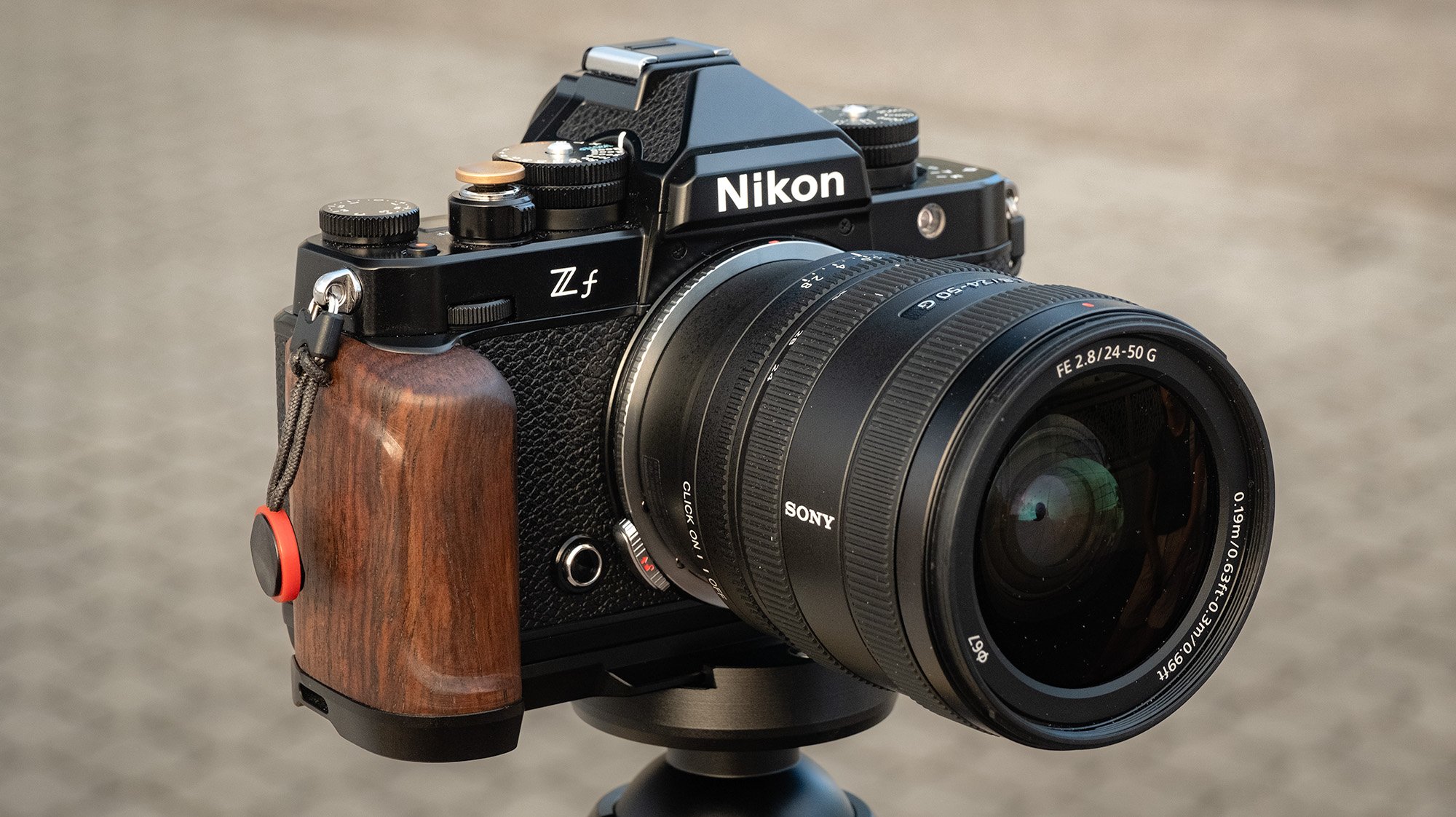
Everything Works
Outside of autofocus, everything else works even better than I hoped.
The aperture ring works as you’d expect to change aperture. When in “A” or Automatic mode, instead of enabling automatic aperture which is handled by the mode dial, it allows you to change the aperture with the command dials.
You have full customization of the function button located on the lens and works just as you’d expect when changing the setting in setup.
AF/MF switch as expected
All lens data is recorded as well including the aperture and focal length. It even records the correct lens, but sadly doesn’t set the correct correction automatically in Lightroom (more on this later).
The Quirks of Adapting
The only drawback or issue I’ve run into when adapting is lens correction. The reason modern optics continues to improve isn’t necessarily groundbreaking new technology in glass or math, its that most brands are pushing the limits of what they can get away with in software corrections. For example the distortion on my Canon RF 14-35mm f/4 is wild at 14mm, but they’ve pushed it that far because they can correct it in camera now, unlike back when you were using a pentaprism on a DSLR with no live previews.





Because of these advancements, lenses like the Sony FE 24-50mm f2.8 exist. However when adapting the lens to another brand, you lose those automatic corrections (in camera). Above you’ll see at 50mm that the distortion is barely noticeable, at 35mm it’s present but nothing unusable, and it’s not till the 24-30mm range that it becomes a lot more apparent. Thankfully it’s not hard to fix.
Once you import your photos into Lightroom, all you need to do is set the lens correction profile to the Sony FE 24-50mm f2.8 and sync all the images taken with that lens. Ironically the listed lens knows what lens you’re shooting on, but gets confused because it’s coming from a Nikon camera. This instantly solves the issue but you will have to be careful of it on wide shots when you’re framing without distortion correction because it does crop a little bit.

No Editing + Manually Corrected in Lightroom from 24mm + kodak portra 800 recipe
The biggest impact this has is if you don’t shoot in raw, the corrections don’t get applied to the JPEG images. I’ve found I can correct them pretty quickly in Lightroom without profiles, but this might be something you don’t want to worry about so just be aware.
The same logic applies for video. The camera won’t automatically correct when recording, thus you’ll have to manually correct for it within your NLE. I’ve found that in Premiere Pro, I can adjust using distortion correction easily and remember that this really only impacts the wider focal lengths. However this does add more work to post processing if you’re planning on using this lens for video.
Thoughts on the Sony FE 24-50mm f/2.8
Outside of adapting this lens to the Nikon Zf, would I buy this lens again? For my needs, absolutely. One stand out feature about the lens is that when you extend it to “Zoom,” you are actually zooming out to 24mm. Thus when the lens is at it’s shortest physical length, it’s at 50mm. I really enjoy this because I find myself shooting between 50mm and 35mm a lot which means I don’t have to extend the lens very much at all. It also means when I’m walking around, I can stay more discrete at 50mm than I would be with an alternative lens.
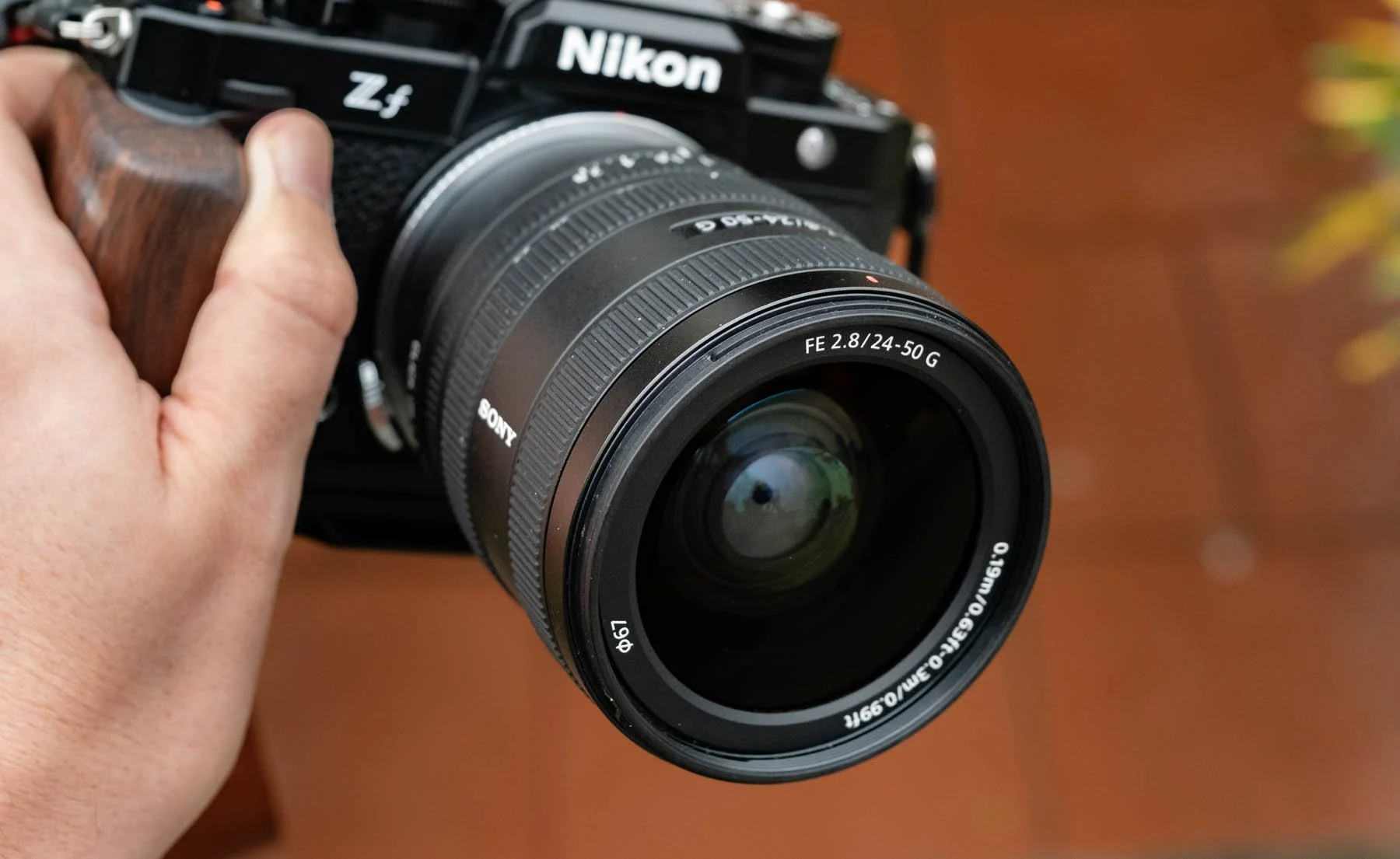
Another feature you can’t read on a stat sheet that I love is the aperture ring. The clicks feel substantial and honestly really pleasing. They match the tactility of the Nikon Zf really well and with this being my first Sony lens, I have to admit it impresses me. When compared to the aperture ring on my Fujifilm XF 18-55 f2.8 II, it’s a night a day difference. But that isn’t saying much because the Fujifilm aperture ring on that lens is terrible. The Sony ring is great, wish it was on more lenses. Also worth noting that you can declick the aperture ring on the Sony FE 24-50mm f2.8 as well, but I would never (at least on the Nikon Zf)
Something worth mentioning because many people don’t realize it is that this lens matches the legendary Sigma 18-35mm f/1.8 lens quite well, if not better. The Sigma has been a staple lens for videographers for over 10 years (myself included, I’ve owned two copies). The Sigma 18-35mm f/1.8 is a lens meant for APS-C cameras meaning it has an equivalent focal length of roughly 28-55mm and an equivalence of f/2.9 aperture in regards to depth of field on Canon cameras. The Sony FE 24-50mm f2.8 is basically the exact same while gaining 4mm on the wide side over the telephoto side, which I think is far more important. Yet it weights considerably less. It’s even comparable to Sigma’s newest version, the 17-40mm f1.8. Yet this lens never gets talked about the same way and I think it deserves more limelight for what it accomplishes.

Sony FE 24-50mm f2.8 + Nikon Zf (no editing + kodak portra 800 recipe)
TLDR
Sony FE 24-50mm f2.8 is great, fills a very unique spot and should get more spotlight if you want performance without heavy weight
Tactile and satisfying aperture ring on a Nikon camera
Adapting to Nikon Zf utilizing the Megadap ETZ has been nearly flawless with surprisingly little drawback. Adds 2mm of length and 43 grams.
Autofocus works similar to a native lens
Biggest drawback is requiring profile or manual distortion correction in post
Would I suggest this to someone looking for this experience? Absolutely. The best part I haven’t even mentioned yet is that using such an adapter gives you access to quite a few Sony E Mount lenses. One of the biggest selling points to Sony is their exceptional first and third part lens options. Anytime a new innovative lens comes out, it’s typically for the Sony E mount. With this setup, you can get access to many of those on your Nikon cameras!
Thanks for reading - if you enjoyed this and want to support my work. Consider joining my newsletter, purchasing a camera guide, grabbing a cool phone wall paper, leaving a comment, or just throwing me a cup of coffee below.